Your Plumber Learned That From a Guy Who Was Just Showing Off
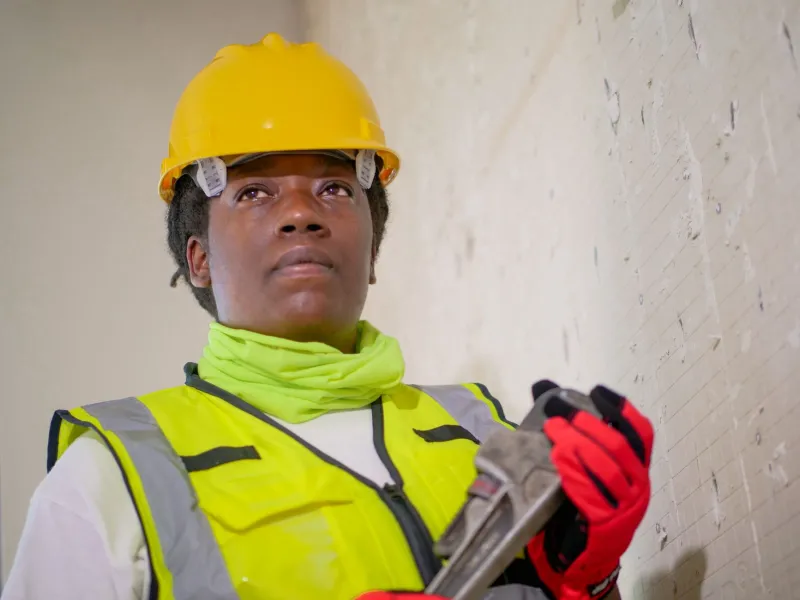
Rick has been a licensed electrician in the Dallas-Fort Worth metro for nineteen years. He has a wall of certifications. He completed a four-year apprenticeship. He can wire a panel blindfolded and has opinions about conduit that most people would find alarming in their specificity.
He also, recently, learned a new junction box technique from a 14-second clip posted by a guy named @sparky_vibes_tx who was, by his own caption, just "messing around on a Saturday."
"I watched it three times," Rick admitted, with the energy of a man confessing something at church. "It was a better approach than what I'd been doing. I've been doing this for two decades and a random dude with a phone just showed me something I didn't know."
Welcome to the 12-second skill economy. Population: everyone, accidentally.
The Tutorial That Wasn't
Here's the thing about the clips that are quietly rebuilding America's vocational knowledge base: almost none of them were designed to teach anybody anything. They were designed to show off, to document, to share a satisfying moment, or to fill a content quota on a slow Tuesday. The education is a side effect.
This distinction matters more than it might seem. A proper tutorial is structured. It anticipates confusion. It has chapters and timestamps and a guy who says "smash that subscribe button" approximately forty-seven times. What short-form work content does is something fundamentally different — it drops you into the middle of a real task, performed by a real person, in real time, with no concession to your ignorance.
And somehow, that works better for a lot of learners.
"I've tried to learn coding from YouTube tutorials three times," said Janelle, a 26-year-old in Minneapolis who now works as a junior front-end developer. "Every time I'd bail around the 45-minute mark. Then I found this creator who was just posting her debugging process — like, real bugs she was actually fixing — in these short clips. Something clicked. I started doing exactly what she was doing, pausing and trying it myself. Within four months I had enough to land my first job."
Janelle's story is one version of a pattern that's showing up across industries with a consistency that's starting to get the attention of people in workforce development.
Trade Workers Become Accidental Professors
Ask a plumber, electrician, HVAC tech, or auto mechanic who posts "day in my life" content whether they consider themselves educators, and you'll get a very specific look. It's somewhere between flattered and baffled, with a side of "please don't make this weird."
DeShawn runs a small auto body shop in Columbus, Ohio. He started posting clips because his girlfriend told him people would find it interesting. "I just thought it was cool stuff. Like, here's a dent being pulled. Here's a rust spot being treated. I didn't think anyone was learning from it."
Then his DMs started filling up with questions. Detailed, specific, clearly-I-tried-this-myself questions. "People were asking about the heat gun settings I used. The specific compound. One guy sent me a picture of a repair he did on his own car and it was actually pretty good. He said he learned it from my clips."
DeShawn now has 340,000 followers. He still doesn't consider himself a teacher. But the comments section of his videos functions as an informal help desk for amateur auto body enthusiasts across the country, and the quality of work being described in those comments has, by his own assessment, gotten noticeably better over time.
This is happening in makeup artistry, carpentry, HVAC maintenance, small engine repair, basic plumbing, welding, roofing, and — perhaps most surprisingly — in highly specialized medical-adjacent skills like wound care and mobility aid adjustments, where caregivers are learning techniques from watching healthcare workers document their shifts.
What the Education Industry Is Quietly Panicking About
The traditional vocational education pipeline in the United States is not cheap, not fast, and not always accessible. Community college certificate programs can cost thousands of dollars and take a year or more. Trade apprenticeships, while excellent, require geographic proximity to a union or contractor willing to take someone on.
Short-form clips cost nothing and are available at 3 a.m. in rural Montana.
Workforce development researchers are starting to ask uncomfortable questions about what this means for traditional credentialing. If someone can demonstrate genuine competence in a skill they acquired through short-form content, does the absence of a certificate matter? The answer, legally and professionally, is often yes — licensing requirements exist for excellent safety-related reasons. But the gap between "what you know" and "what you can prove you know" is getting strange.
"We're seeing applicants come in with real skills and no paper," said one HR director at a regional HVAC company who asked not to be named because, in their words, "this is a weird thing to say officially." "They learned from videos. They can do the work. We still have to put them through our certification process, but they're not starting from zero. They're starting from... somewhere real."
The question of whether short-form skill acquisition can or should be formally recognized is one that workforce policy people are beginning to wrestle with. Some forward-thinking community colleges are experimenting with "recognition of prior learning" assessments that don't ask where you learned something — only whether you can do it.
The Algorithm as Guidance Counselor
There's a genuinely wild wrinkle in all of this that doesn't get enough attention: the algorithm is making career decisions for people.
When someone's FYP starts serving them welding clips because they watched one welding clip, they are being nudged — by a machine optimized for engagement, not human flourishing — toward a potential vocational interest. Some people follow that nudge off a cliff into an expensive equipment purchase they regret. But some people follow it into an actual career.
"I was pre-law," said Marcus, a 24-year-old now enrolled in a HVAC certification program in Phoenix. "I kept getting carpentry clips. I don't know why. I watched them all. Then I watched more. Then I bought some wood and tried it. Then I realized I liked working with my hands more than I liked anything about law school. I'm not saying the algorithm saved me, but... the algorithm kind of saved me."
BlipSnips is, at our core, a celebration of what happens when short content does something nobody expected. The 12-second skill economy is maybe the best example of that we've encountered. Nobody planned it. Nobody funded it. A bunch of people just pointed their phones at the thing they were already doing, and accidentally built a vocational education system that runs on vibes, authenticity, and the occasional satisfying close-up of a perfectly soldered joint.
Rick the electrician, for what it's worth, has now started posting his own clips.
"If @sparky_vibes_tx can teach me something," he said, "maybe I can teach somebody else something." He paused. "I'm still not putting 'educator' in my bio though."