Clip, Cringe, Repeat: Why Creator Apologies Under 60 Seconds Are Basically Gasoline

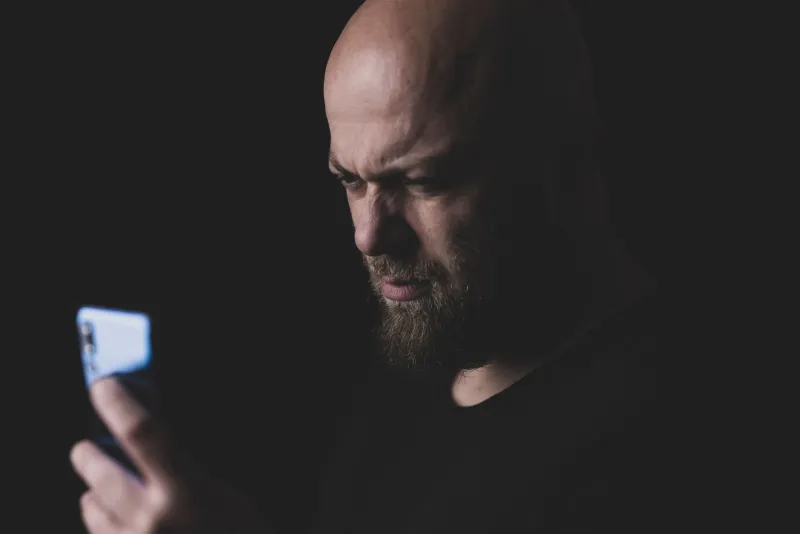
Photo: person looking stressed holding smartphone with social media comments, via pngteam.com
Somewhere between the shaky camera angle and the conspicuously perfect lighting, the apology clip was born. It arrived draped in a hoodie, voice cracking just enough, eyes doing that thing where they glance slightly upward to signal deep personal reflection. And then — within roughly 45 seconds — it was over. The creator exhaled. The comment section detonated.
Welcome to the shortest, most chaotic genre in short-form video: the creator apology clip. It's part theater, part damage control, and almost entirely counterproductive.
The Format Is Doing You Dirty Before You Even Hit Record
Here's the fundamental problem nobody seems to be telling these creators before they press publish: the very architecture of short-form video is engineered against sincerity. Platforms reward snappy hooks, punish slow builds, and condition audiences to expect entertainment value in every frame. When you try to wedge genuine accountability into that same container, something breaks — and it's usually the apology.
Dr. Lena Marsh, a communication specialist who consults with media personalities navigating public fallout (and who, yes, has definitely watched too many of these clips professionally), puts it bluntly: "Authentic remorse takes time to develop, time to articulate, and time for an audience to absorb. Short-form video compresses all three of those stages into a format where the audience's finger is already hovering over the swipe."
In other words, you've got roughly eight seconds to convince someone you're genuinely sorry before their thumb makes the decision for them. That's not a confession booth. That's a speed round.
The Anatomy of a Doomed Apology Clip
Let's break down the recurring elements that show up in virtually every apology clip that's gone sideways — because the patterns are almost comedically consistent.
The Vague Open: "So, a lot of you have been asking about what happened..." Nobody says what actually happened. This immediately signals to experienced internet audiences that the creator is not, in fact, ready to say what actually happened.
The Passive Construction: "Mistakes were made." "People were hurt." "Things got out of hand." The subject of every sentence is mysteriously absent. Accountability requires a subject. Grammarians and the general public agree on very little, but they agree on this.
The Pivot to Self: Within 20 seconds, the clip has somehow become about how hard this has been for the creator. The audience — the one that was presumably wronged or troubled — becomes a supporting character in a story about the creator's emotional journey. Comments sections have coined a term for this: "the switcheroo."
The Abrupt Resolution: "Anyway, I just wanted to address this and move forward." Cut. The clip ends. The discourse begins.
Any one of these elements, in a longer format, might be survivable. Packed together into under a minute? It's a combustion event.
The Audience Isn't Fooled — They're Entertained
Here's the part that complicates the whole conversation: a significant chunk of the audience watching these apology clips isn't watching to forgive anyone. They're watching because it's content. Riveting, cringey, occasionally jaw-dropping content.
A 2023 survey by digital media research firm Pulse Collective found that 61% of respondents admitted they watched creator apology videos primarily out of curiosity or entertainment, not because they were personally invested in the outcome. Only 18% said a short-form apology had meaningfully changed their opinion of a creator in a positive direction.
That's a brutal conversion rate for a format that requires significant emotional labor to produce.
"The apology clip has become its own genre of spectator sport," says Marcus Tillman, a digital culture critic and newsletter writer based in Austin. "People aren't tuning in for closure. They're tuning in to watch someone try to thread an impossible needle. And when it goes wrong — which it usually does — that clip becomes a second piece of viral content, completely independent of the original controversy."
So not only does the apology fail to contain the fire — it frequently adds kindling.
When Short-Form Actually Made It Worse: A Brief Hall of Fame
Without naming names (because we enjoy existing on the internet), the BlipSnips archives of creator chaos offer some illuminating case studies in format-induced disaster.
There's the gaming creator who tried to address accusations of toxic behavior on stream with a 52-second clip that spent 30 of those seconds explaining how much their community meant to them — before the community they'd allegedly mistreated had been acknowledged at all. The clip was reedited by fans within hours, with subtitles added to highlight every moment the creator centered themselves. It got three times the views of the original.
Then there's the lifestyle influencer who addressed a sponsored content controversy with what she described as "a quick transparency moment" — a phrase that communication professionals have since used as a teaching example of what not to say. Transparency, by definition, is not a moment. It's a posture. You can't briefly be transparent.
And perhaps most instructively, there's the cooking creator who addressed a cultural appropriation critique with a clip that was — by most accounts — genuinely thoughtful and well-intentioned, but clocked in at 58 seconds. The comment section's primary complaint? "That's it?" Length, it turns out, functions as a proxy for effort. A short apology, regardless of content, reads as a short amount of care.
So What Actually Works?
Communication experts who spoke with BlipSnips were surprisingly consistent in their recommendations, and none of them involved a ring light.
First: don't apologize in the format where the controversy happened. If you went viral on a short-form platform, your apology probably shouldn't live there. A longer YouTube video, a written statement, or a live stream that allows for real-time accountability tends to land with more credibility — not because length equals sincerity, but because choosing a harder, slower format signals that you're not optimizing for algorithmic performance.
Second: be specific. Name the thing. Say the thing. Passive construction is the enemy of believable remorse.
Third — and this one's genuinely counterintuitive — don't rush to post. The instinct in creator culture is to respond fast, because the news cycle moves fast. But an apology posted six hours after a controversy breaks, while the audience is still in maximum outrage mode, is almost always received worse than one posted after a genuine period of reflection. Silence, for a short window, is not the same as guilt. It can actually read as seriousness.
The Uncomfortable Truth
Maybe the deepest issue with the short-form apology isn't craft or timing or word choice. Maybe it's that the format has trained audiences to expect a certain kind of performance — and genuine accountability isn't a performance. It's slow, it's uncomfortable, it doesn't have a satisfying arc, and it almost never fits in under a minute.
The clip economy is magnificent at a lot of things. Distilling joy. Compressing humor. Making a three-second dog video feel like a complete emotional experience. But contrition — real, meaningful contrition — might just be one of the few human experiences that refuses to be blipped.
Some things, it turns out, can't be snipped.